
Dense Breasts, Mammogram
Dense Breasts Explained: Why Some Women May Need More Than a Mammogram
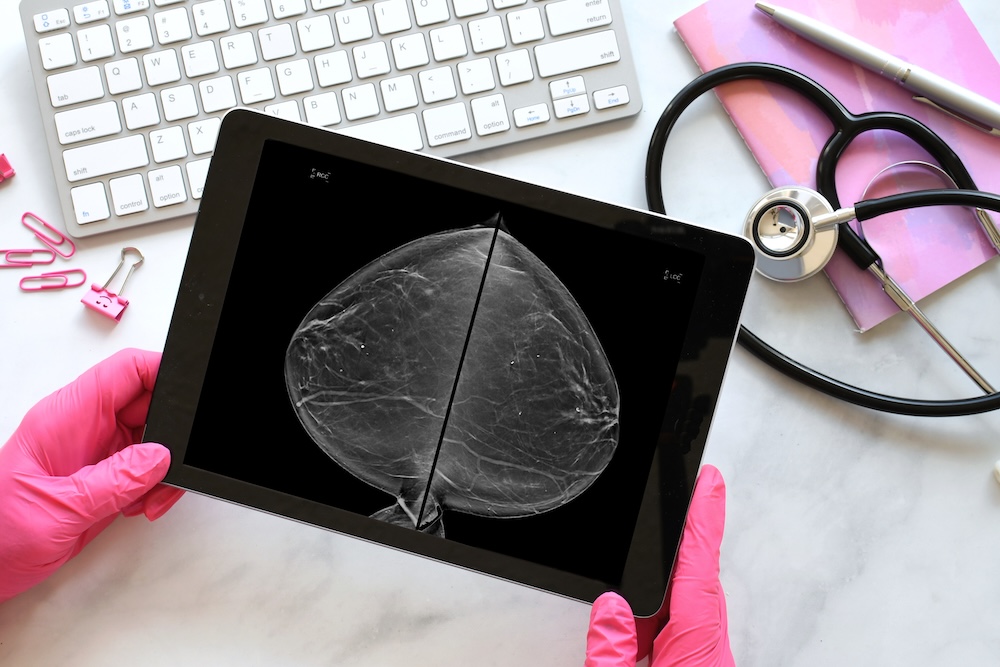
Dense breasts have more glandular and fibrous tissue than fat. On a mammogram, dense tissue shows up white—and so do most tumours—making small cancers harder to spot. Women with dense breasts may benefit from additional imaging, such as breast ultrasound or 3D mammography (digital breast tomosynthesis), alongside their routine mammogram. Breast density can only be confirmed by a mammogram, not by how breasts look or feel.
Breast density describes the proportion of glandular and fibrous (connective) tissue compared with fatty tissue, as seen on a mammogram. Radiologists grade it using four BI-RADS categories, from almost entirely fatty (A) to extremely dense (D). Categories C and D are considered “dense.”
Density has nothing to do with breast size or firmness—two women with similar-looking breasts can have very different density readings. It is also common: studies have found that Asian women tend to have a higher prevalence of dense breast tissue than Caucasian women, even after accounting for age and body weight.
| BI-RADS Category | Description | Considered Dense? |
|---|---|---|
| A | Almost entirely fatty | No |
| B | Scattered areas of density | No |
| C | Heterogeneously dense | Yes |
| D | Extremely dense | Yes |
Density matters for two separate reasons:
|
1. It can mask cancers on a mammogram Because dense tissue and tumours both appear white, dense areas can hide small lesions. Research indicates that mammographic sensitivity falls by roughly 30–48% in women with dense breasts, compared with an overall mammogram sensitivity of around 70%. |
|
2. It is an independent risk factor Beyond the masking effect, higher breast density is itself associated with a higher chance of developing breast cancer—studies estimate around a 4–6 times higher risk for women with the densest breasts compared with those with the least dense. |
This combination of being harder to detect and carrying a higher baseline risk is why density is worth understanding rather than ignoring.
You cannot tell by touch, and neither can your doctor by examination alone. Breast density is determined only when a radiologist reads your mammogram, and in many reports it is recorded as a BI-RADS density category. If you have had a mammogram, you can ask your doctor what your density category was. As a general pattern, breast tissue tends to become less dense with age as more fatty tissue develops, which is one reason mammograms often become easier to interpret in older women.
These are complementary tools, not competing ones. A doctor recommends the right combination based on your age, density, symptoms, and personal risk.
| Method | How It Works | Where It Helps | Things to Note |
|---|---|---|---|
| Mammogram (2D) | Low-dose X-ray of the breast | Recommended first-line screening test; only method with proven mortality reduction in population screening (MOH / SCS) | Sensitivity is reduced in dense breasts |
| 3D Mammography (DBT) | Takes multiple thin X-ray “slices” to build a 3D image | May improve detection in dense breasts and reduce unnecessary call-backs | Still uses X-rays; availability and cost vary by clinic |
| Breast Ultrasound | Uses sound waves; often used as a supplement | Can pick up some cancers hidden on a mammogram in dense breasts | No radiation, but tends to produce more false positives |
| Breast MRI | Magnetic resonance imaging | Reserved for women at high risk (e.g. strong family history, genetic factors) | Not a routine screening test for average-risk women |
The takeaway: For women with dense breasts, the question is often not “which single test,” but whether a standard mammogram is sufficient on its own—a discussion best had with your doctor.
Singapore’s national guidelines (Health Promotion Board, Ministry of Health, and Singapore Cancer Society) recommend the following baseline:
|
Women aged 40 & above: Recommended to begin regular breast screening. |
|
Women under 40: Routine mammograms are not usually recommended unless at high risk. |
|
Family history: Having a first-degree relative with breast cancer doubles risk; screening may begin 10 years before their age of diagnosis (or at age 40). |
|
Breast awareness: Monthly breast self-examinations are recommended from age 20 to become familiar with what is normal for you. |
If your report indicates dense breasts, raise this with your physician. Fusion Medical offers digital breast tomosynthesis (3D mammography) and supplementary breast ultrasound as part of our women’s health screening services.
Dense breasts are common and not a disease. They do, however, make mammograms harder to read and are linked to a modestly higher breast cancer risk—making thorough screening important, not a cause for panic.
No. Density refers to tissue composition as seen on a mammogram, not firmness or breast size, so it can only be determined through imaging.
Having dense breasts does not mean you will develop breast cancer, but it is associated with a slightly higher relative risk compared to non-dense tissue.
Possibly. Supplementary ultrasound can detect some lesions masked by dense tissue, but it also produces more false alarms. Whether it is necessary depends on your overall health profile and doctor’s advice.
Mammograms are recommended every 2 years from age 50, or annually from ages 40–49 after discussing with your doctor. Women at higher risk may begin earlier.
The compression required is similar to a standard 2D mammogram. Any discomfort is brief and comparable to traditional screening.
Disclaimer: This article is for general information and does not replace personalised medical advice. Please consult a doctor regarding your individual screening needs.
At Fusion Medical, every health screening package concludes with a doctor consultation to review your results in plain language, so you are never left to interpret a report alone.

In Singapore, about 430,000 adults aged 18–69 have pre-diabetes, and without changes to diet and activity, roughly one in three goes on to develop type 2 diabetes within eight years.

Learn about lung cancer in Singapore, including key statistics, symptoms, causes in non-smokers, screening options, and why early detection matters.

Dr Wenus Ho is a family physician and a designated workplace doctor with more than a decade of clinical experience. She is also currently a postgraduate tutor for the Graduate Diploma of Family Medicine (GDFM) Training Program in the Yong Yoo Lin School of Medicine, Singapore....

After graduating from Guys’, King’s and St Thomas’ School of Medicine in the United Kingdom, Dr Juliana went on to complete her Graduate Diploma in Family medicine at the National University of Singapore. She also has completed her diploma in Occupational Medicine. Dr Juliana applies her...

Dr Yong graduated from University College London, United Kingdom, with a Bachelor of Medicine & Bachelor of Surgery with distinction in medical sciences. She has more than 10 years of experience as a general practitioner, and was accredited as family physician by the Family Physician Accreditation...
Start your skin health restoration journey with us today!

501 Orchard Rd #04-11, Singapore 238880

Mon-Fri :8:30am – 5:30pm
Sat :8:30am – 1:00pm
Sun / PH :Closed
1 Fusionopolis Link, #01-05 Nexus
@ One-North , Singapore 138542
Mon-Fri :8:30am – 5:30pm
Sat/Sun / PH :Closed


Fat Freeze + X Wave at S$98
Vanquish ME + X Wave at S$199

