
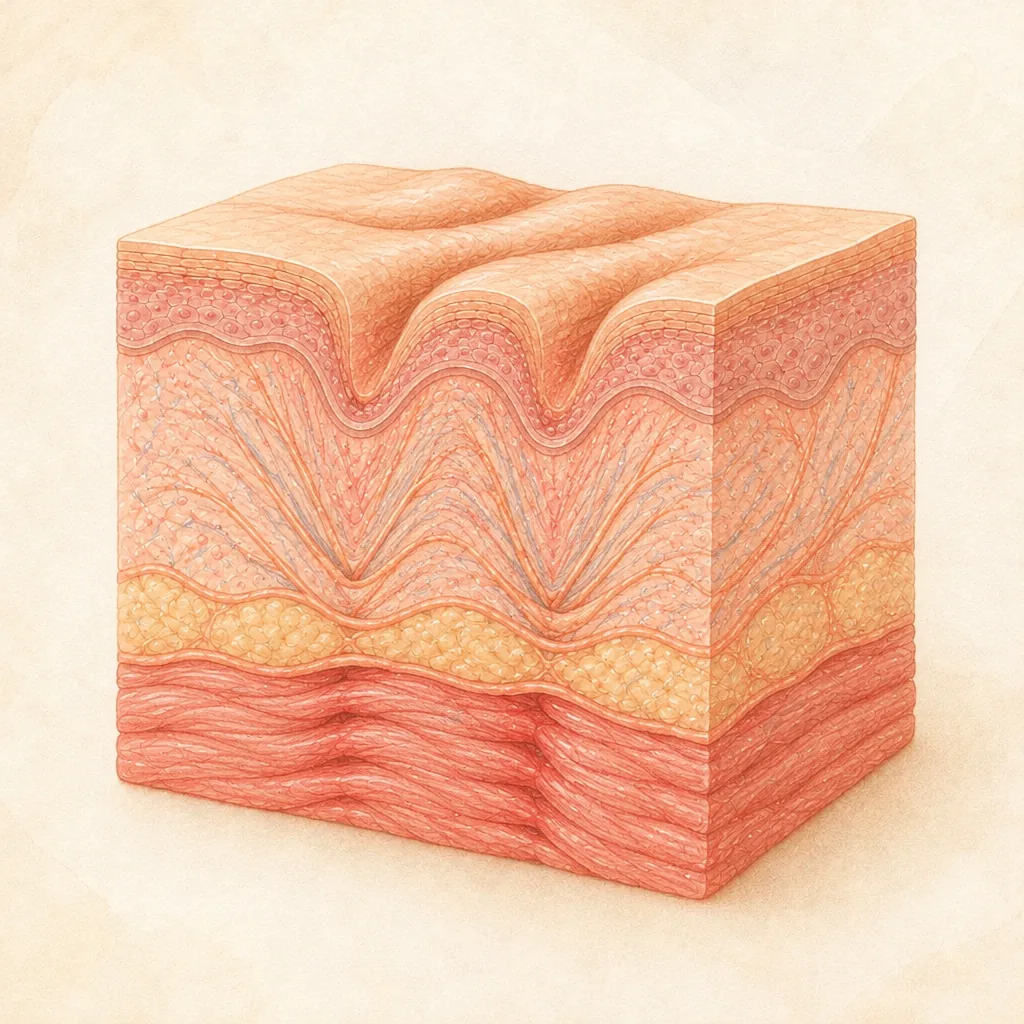
Why expression lines form
With age the skin holds less collagen, elastin and hyaluronic acid, so it creases more easily. Where the same muscles contract again and again, the creases deepen into frown lines, crow's feet and forehead lines.



Anti-wrinkle injections · Singapore
A prescription treatment that temporarily relaxes the muscles behind expression lines, smoothing existing lines and helping to prevent new ones from forming.
Relaxing the muscles behind frown and forehead lines.
Anti-wrinkle injections use a prescription medicine, obtained from bacteria, that blocks the nerve signals telling muscles to contract. By temporarily relaxing the muscles that cause wrinkles, they smooth frown lines, crow's feet and forehead lines, and help prevent new ones from forming.
Natural substances in the skin decrease with age, causing wrinkles to form: collagen, the major structural protein; elastin, the protein that lets tissue stretch; and hyaluronic acid, which gives skin volume. Repeated muscle contractions from frowning, squinting or raising the eyebrows add to this, forming frown lines, crow's feet and forehead lines.
Anti-wrinkle injections also have medical uses, including chronic migraine, muscle spasms, cervical dystonia (involuntary contraction of the neck or shoulder muscles that holds the head in an uncomfortable position), excessive underarm sweating (hyperhidrosis) and some bladder disorders. It is a prescription-only treatment, so a doctor assesses you before any injection.
How it works
An anti-wrinkle injection blocks signals from nerves — mostly the signals that make the underlying muscles contract. With less contraction, the skin above creases less and lines soften. It usually starts to work one to three days after treatment, with visible results in about one to two weeks.
Why expression lines form
With age the skin holds less collagen, elastin and hyaluronic acid, so it creases more easily. Where the same muscles contract again and again, the creases deepen into frown lines, crow's feet and forehead lines.
Blocking the nerve signal
The medicine blocks the signals that nerves send to selected muscles. The muscles that cause wrinkles relax, their contraction is temporarily reduced, and the lines above them smooth out.
Frown lines, crow's feet and forehead lines
Relaxing the muscles of the upper face is the most familiar use of anti-wrinkle injections.

Lips, jaw, lower face and neck
Cosmetic uses also include relaxing muscles of the lower face and neck.
Personalised assessment
Cosmetic uses involve relaxing facial and neck muscles. Our doctors look at the movement that creates each line, not only the line itself, before recommending where — and whether — to treat.
Pregnant, breastfeeding or allergic to cow's protein? This treatment is not recommended.
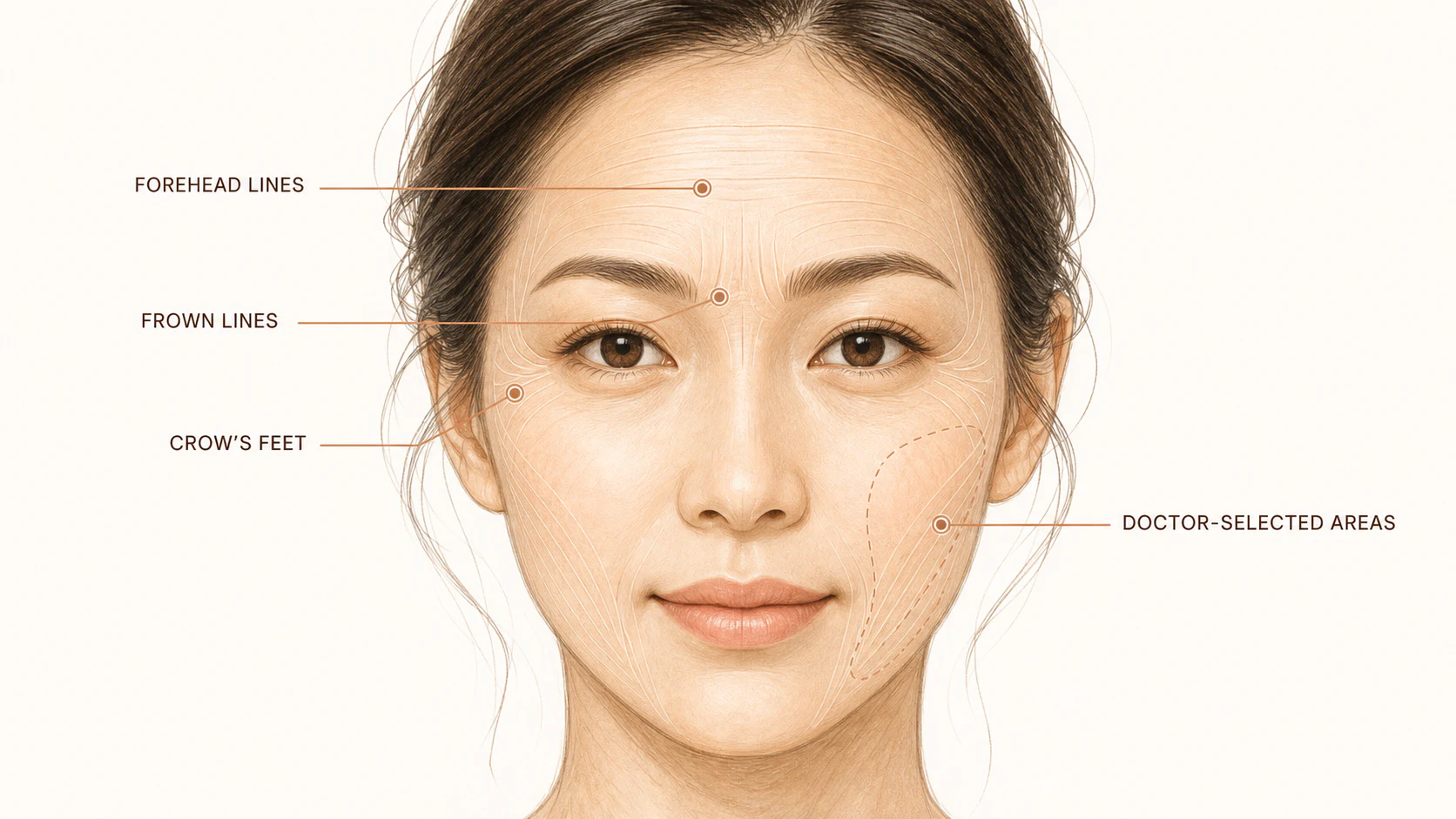
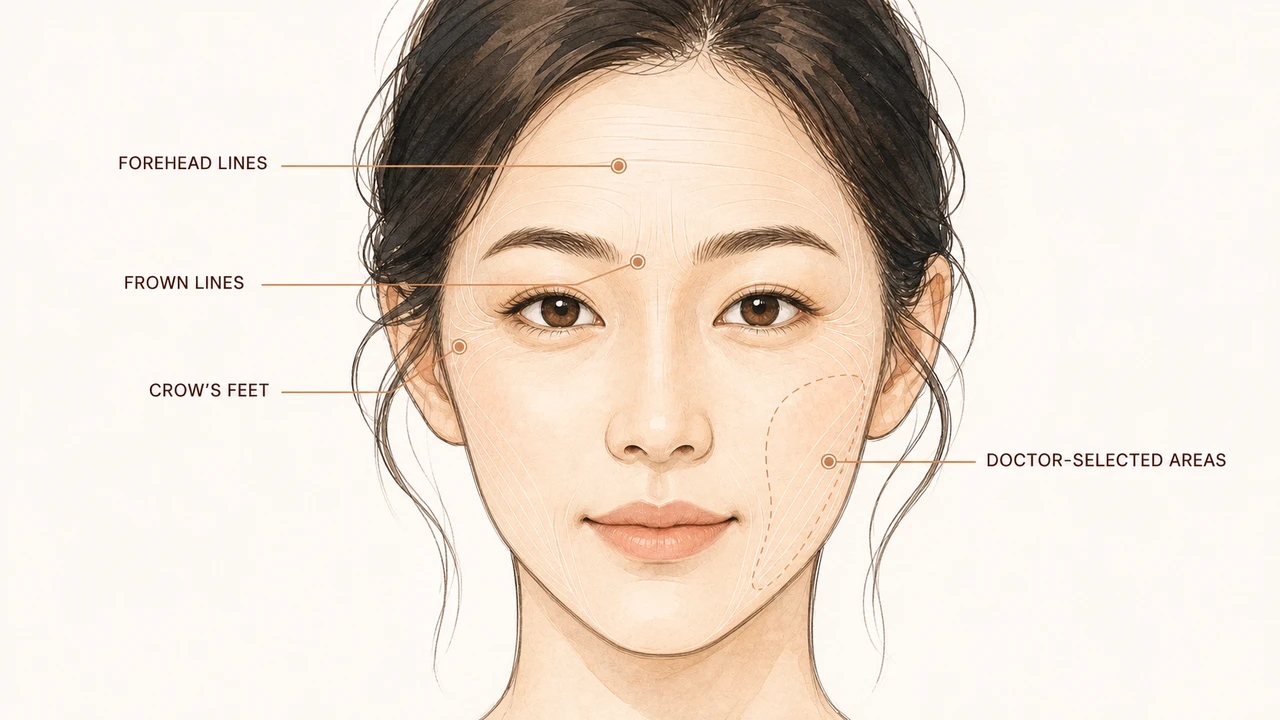
Relaxing the muscles used to frown or raise the eyebrows smooths frown lines and horizontal forehead lines.
Lines at the outer corners of the eyes, deepened by squinting, soften as the surrounding muscle relaxes.
Relaxing the muscle around the mouth can reduce lines around the lips.
Relaxing the jaw muscle can slim the lower face. For a V-shape, it may be combined with dermal fillers to the chin.
Relaxing selected muscles of the lower face and neck can help lift the lower face and chin.

Your treatment journey
Your doctor reviews your concerns, medical history and medicines, and looks at how your facial muscles move, to check the treatment is suitable for you.
The treated area is cleansed, then the injections are given. Each area takes around 10 minutes, and there may be slight discomfort during the injections.
For 2–4 hours afterwards, avoid massaging your face, strenuous exercise and lying down. Any redness or swelling usually settles the same day.
The effect starts in 1–3 days and is visible in about 1–2 weeks. Repeated treatments are needed for a continued effect, and each one may last longer as the muscles learn to relax.
From our doctors
Our doctors explain how repeated facial movement creates lines, and why an assessment for anti-wrinkle injections looks at the movement behind a wrinkle, not just the wrinkle itself.
Safety & expectations
The aim is to reduce excessive muscle activity while keeping your expressions natural.
Anti-wrinkle injections contain a prescription-only medicine and are given by a doctor. Redness or swelling usually settles within the day. Tell your doctor if you are pregnant, breastfeeding, allergic to cow's protein or have a nerve or muscle condition, and seek urgent care for any difficulty swallowing, speaking or breathing.
Anti-wrinkle injections usually start to work one to three days after treatment, and most people see visible results in about one to two weeks. Results are likely to last up to 6 months, depending on your lifestyle, metabolic rate and facial strength. The first treatment tends to be the shortest-lived; with repeated sessions the muscles are trained to relax, which can stretch how long each treatment lasts.
An anti-wrinkle injection contains a purified protein that temporarily relaxes the muscles that crease the skin. It is a prescription-only treatment, so your doctor reviews your medical history, medicines and allergies (including any allergy to cow's protein), and assesses how your face moves, before treatment.
Frown lines, crow's feet and forehead lines form where the skin is creased again and again by frowning, squinting or raising your eyebrows, and they show more as collagen, elastin and hyaluronic acid decrease with age. Some people naturally have stronger muscle activity in certain areas, which is why lines differ between people of the same age. Anti-wrinkle injections target the movement behind these lines.
Anti-wrinkle injections are not meant to stop you frowning. The aim is to reduce excessive muscle activity rather than remove facial movement. Your doctor assesses how your muscles move, not just the wrinkle itself, before deciding where and how much to inject. Responses vary between people, so discuss how much movement you would like to keep.
Downtime is minimal. You may notice some redness or swelling after anti-wrinkle injections, which should subside within the day. For 2–4 hours after treatment, you are strongly encouraged not to massage your face, do strenuous exercise or lie down. The procedure itself takes around 10 minutes for each treated area.
Anti-wrinkle injections are not recommended if you are pregnant or breastfeeding, or if you are allergic to cow's protein. Tell your doctor about your medical history, any nerve or muscle condition, the medicines you take and any previous injections, so they can confirm whether the treatment is suitable for you.
Redness or swelling at the injection sites should settle within the day, and there may be slight discomfort during the injections. Bruising, headache, temporary unevenness, or a drooping eyelid or brow can occur. Rarely, the effect of anti-wrinkle injections can spread and cause difficulty swallowing, speaking or breathing; seek urgent medical attention if this happens.
Yes. Cosmetic uses of anti-wrinkle injections include jaw slimming and lifting the lower face and chin, as well as reducing lines around the lips. For a V-shaped face, jaw slimming can be combined with dermal fillers to improve the appearance of the chin. Your doctor will discuss whether to substitute or combine treatments for the result you want.
Doctor-led care
Appointments
Book a consultation to see whether anti-wrinkle injections suit your concerns, or whether another treatment could work better alongside them.